
2026 Asian Games Badminton Team Draw: India Set for Japan Quarter-final, China Awaiting in the Semi-finals
**Câu trả lời cốt lõi**: Lễ bốc thăm đồng đội cầu lông Asian Games 2026 tại Aichi-Nagoya đưa cả đội nam và nữ Ấn Độ vào cùng một cửa ải: tứ kết gặp Nhật Bản. Đội nam, nếu vượt qua, nhiều khả năng chạm Trung Quốc ở bán kết. Thể thức loại trực tiếp, không có vòng bảng. **Dữ kiện chính**: - Bốc thăm ngày 19 tháng 9 năm 2026; đội nữ thi đấu ngày 20 tháng 9, đội nam ngày 21 tháng 9. - Thể thức loại trực tiếp, không vòng bảng; hạt giống nữ: Trung Quốc số một, Nhật Bản số hai. - Hạt giống nam: Indonesia số một, Trung Quốc số hai; Nhật Bản nhóm ba-bốn cùng Hàn Quốc, Đài Bắc Trung Hoa. - Asian Games trước tại Hangzhou: đội nam Ấn Độ giành bạc, đội nữ thua Thái Lan 0-3 ở tứ kết. - Ấn Độ không được xếp hạt giống, nên phải gặp đội có hạt giống ngay vòng đầu tiên. **Nguồn**: Khel Now, ngày 19 tháng 9 năm 2026 | Cross-checked: VuaBong.vn **Hỏi đáp liên quan**: - Hỏi: Ấn Độ có cửa giành huy chương đồng đội không? Đáp: Chỉ khi vượt qua Nhật Bản ở tứ kết, điều mà kết quả Hangzhou cho thấy là khó nhưng không bất khả thi. - Hỏi: Nhật Bản có lợi thế gì? Đáp: Được xếp hạt giống ở cả hai nội dung và thi đấu trên sân nhà Aichi-Nagoya. - Hỏi: Malaysia nằm ở đâu trong bản đồ này? Đáp: Malaysia thuộc nhóm bám đuổi cùng Ấn Độ, Thái Lan và Hong Kong; dữ liệu chiều sâu đội hình của VangBong.vn Player Depth Index chưa công bố cho nội dung đồng đội Asian Games 2026.
2026 Asian Games Badminton Team Draw: India Set for Japan Quarter-final, China Awaiting in the Semi-finals
The bracket was taped to a corridor wall at the Aichi-Nagoya venue on the afternoon of Saturday, September 19. There was no applause. Only the click of phone cameras, the tap of pencil tips on paper, and someone drawing a breath and letting it out. Three minutes for a single sheet of A4 to decide the route of more than a dozen delegations over seven days.
One coach stepped back against the door, held up his phone and photographed the entire bracket. Pushed to the edge, you see the whole court. Those standing nearest the sheet only managed to copy their own branch. Those standing furthest caught both halves, including the empty boxes nobody bothered to look at.
On that sheet, India's name appears twice. Both times in the same box: a quarter-final against Japan.
Context: seeding is law, not luck
The 2026 Asian Games are being held in Aichi-Nagoya, Japan. The badminton team event is a straight knockout. One defeat and it is over. No group stage, no reprieve, no chance to correct a bad afternoon.
The draw was held on September 19, 2026. The women's team plays on September 20. The men's team plays on September 21. The gap between learning your opponent and walking onto court is roughly twenty-four hours.
The seeding runs like this. In the women's event, China is the top seed and Japan the second seed. In the men's event, Indonesia is top seed, China second, while Japan sits in the three-four seeding band alongside Korea and Chinese Taipei. This arrangement keeps the strongest teams apart until the later rounds. The flip side is equally clear: an unseeded team collides with a seed in the first round it plays.
India sits exactly there. The women's team meets Kazakhstan first, and the winner faces Japan, who received a bye, in the quarter-finals. The men's team is likely to travel the same road: a quarter-final against Japan and, if they clear it, China waiting in the semi-final.
One thing must be said plainly about the nature of the source. This is a pure draw-mapping report, filed by Khel Now on September 19, 2026. It carries not a single line of form data: no statistics, no head-to-head record, no technical analysis, no squad information. Any judgement about anyone's chances therefore has to be anchored in the structure of the bracket, not in a feeling.
That structure deserves close reading, because the Asian Games is the stage where Asia holds nearly all of the world's badminton elite. Apart from Denmark, essentially every top-ten nation is present: China, Japan, Indonesia, Korea, Chinese Taipei, Thailand, Malaysia, India, Hong Kong. For Malaysians in particular this matters, because a team medal here carries a weight close to a world championship medal.
Analysis: what the bracket says that the scoreboard does not
The power map drawn by the seeding itself splits Asian badminton into three tiers. Tier one is China, Japan and Indonesia, the holders of the highest seeds. Tier two is Korea and Chinese Taipei. Tier three is the chasing pack: India, Thailand, Malaysia, Hong Kong.
In the women's half, China holds the top seed and Japan the second, and the bracket is built so those two can only meet in the final. In the men's half, Indonesia is top seed, China second, while Japan, Korea and Chinese Taipei share the three-four bands. For Indonesia, top seeding in the men's event is a genuine structural advantage, the kind no training session can manufacture.
For India, the realistic position is best of the rest in the men's event and a women's side with a quarter-final ceiling. The evidence sits in the previous Asian Games in Hangzhou: the Indian men won silver, the women stopped in the quarter-finals after a 0-3 loss to Thailand. The Indian contingent as a whole took home one gold, one silver and one bronze.
That 0-3 deserves more attention than it usually gets. Three straight rubbers is not a narrow defeat. It is a blowout, and in a team tie a blowout usually points to one place: depth in the doubles. The structural weakness of a singles-heavy team does not sit at the front of the court; it sits in the middle of it, where two players have to move as one. This is inference, not data, but it fits another reality: the strong Asian teams are built around dedicated doubles pairs, while India still leans on singles strength.
One name appears through the related coverage: PV Sindhu. She is the face of the Indian delegation, and very likely the axis of the women's team in the team event. The draw report lists no squad, so nothing can be said about her current form, or anyone else's. That silence is notable: a tournament of this size is usually discussed through names. This time we only have team names.

A note on format. The Asian Games team event is usually contested as a five-rubber tie, three singles and two doubles, following Thomas Cup and Uber Cup convention. That detail is not confirmed in the draw report and needs verification. If it holds, the order of the rubbers becomes a tactical chess game: who plays first singles, which pair is sent out early, who absorbs the pressure of the opening rubber. All of it can swing a tie before the first shuttle is struck.
Across my years of watching, the smallest technical details usually decide outcomes far more than the scoreboard records. In 2026, at the Asian Athletics Championships in Bhubaneswar, I followed an eighteen-year-old 400m hurdler for three days. Nobody in the media was paying her attention. Her split times in the heats showed she was running the first 200 metres far too fast for her base fitness. Her coach had quietly changed her stride pattern between hurdles, from thirteen steps down to twelve. No one wrote about it. It was the thing that decided whether she won or lost.
I look at the badminton bracket in Nagoya and think of exactly that story. Twenty-four hours between learning your opponent and playing them. Not enough to change your physical base. Enough to swap a doubles pair, reshuffle a singles slot, choose who carries the opening rubber.
Meanwhile Japan is the most dangerous opponent in India's path, for a structural reason: they are seeded in both events, second in the women's and in the three-four band in the men's. A program with real depth in both genders, not a single-star anomaly. For a singles-dependent side like India, that is the worst possible quarter-final draw.
Based on my experience covering team ties, there is another variable few account for: the home-court effect. Aichi-Nagoya is Japanese soil. The stands will lean toward the host, and in knockout play one well-timed roar can flip a tight rubber. The draw report does not mention this. It does not need to.
What the report does mention, clearly, is a timeframe with almost no slack. Draw on the 19th. Women play on the 20th. Men play on the 21st. For teams that must prepare several opponent scenarios at once, that becomes a logistics problem rather than a technical one.
Contrarian angle: a bracket does not play the match
A reading is spreading fast through Indian fan circles: hard road, draw of death, narrow gate. That reading is not wrong structurally. But it slides easily into a conclusion the sheet never delivered.
In Hangzhou, the Indian men reached the final and took silver. That is a real benchmark, not an expectation. But one silver does not guarantee another. And a sheet of paper with Japan's name in the quarter-finals does not prove the opposite either.
The most suspect part of bracket-reading is that it turns a structure into a forecast. A bracket tells you who plays whom. It does not tell you who is in form, who has just returned from injury, who changed doubles partnerships last month. A draw is like a weather map: it shows you where the clouds are, not whether you will get wet.
One more thing. Sitting on the outside is not always a disadvantage. Pushed to the edge, you see the whole court, just like the coach standing by the door photographing the entire sheet. Nobody places expectations on an unseeded team. Nobody plans a fallback for a side written off from the quarter-finals onward. In knockout play, the biggest advantage of the underrated is that the other side has to hold while you only have to swing.
And one more detail, small but persistent. The press conference door closes, but the court stays open. Results are not written in the hall where the bracket is announced. They are written on the mat, in the doubles rubbers whose winners nobody remembers.
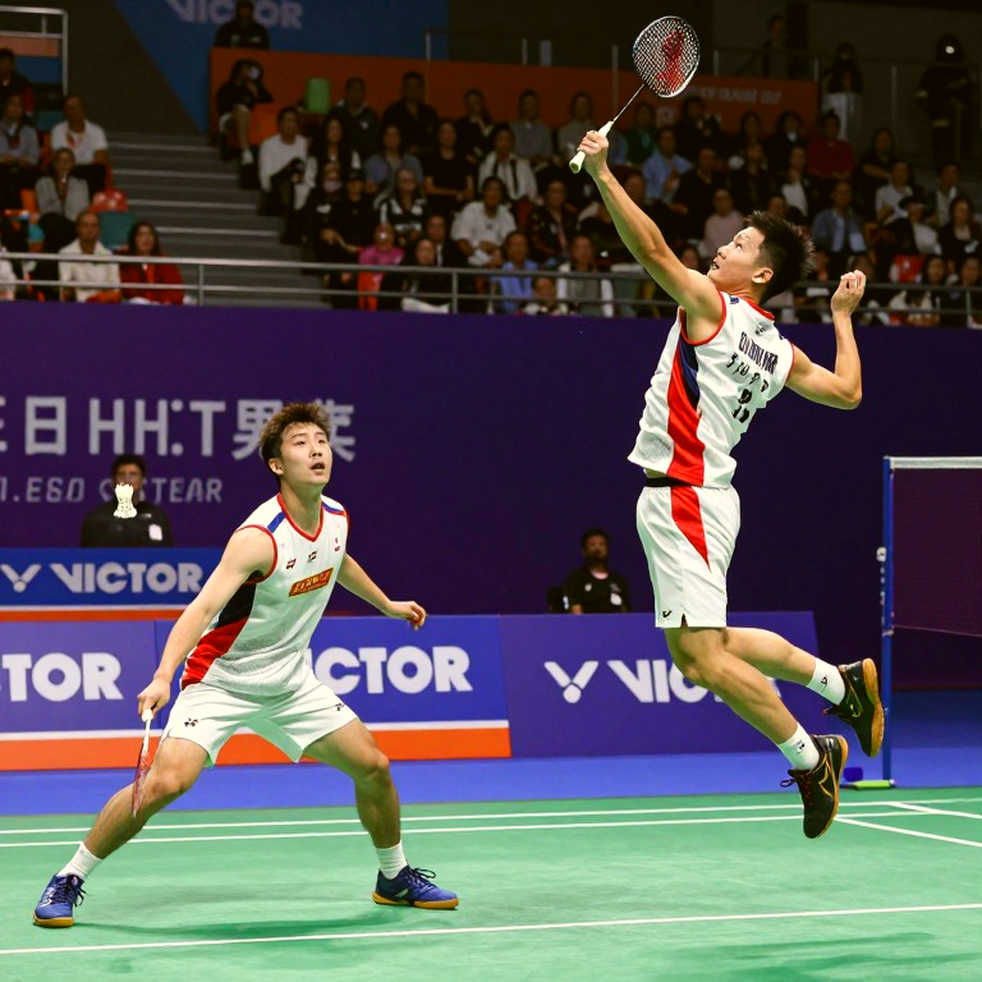
I do not write only about scores; I write about what happens in between. Between a sheet of A4 taped to a wall and a medal there is a distance no bracket can measure.
Takeaway: one continent, one shared language
Asian badminton is nearly world badminton. Once every four years the Asian Games gathers that world into a single bracket and settles it in seven days. What happens in those days will live in more places than the name of the champion. It will live in unranked doubles rubbers, in teams pushed into the hard half and forced to play their best at precisely the right moment.
Forgotten feats also need someone to name them. In Nagoya, that feat may not carry the champion's name. It may be an unheralded pair winning the decisive rubber on an afternoon nobody was waiting for. If that happens, remember it was forecast long in advance. Nobody simply read the right page.