
Vietnamese Table Tennis and the Data Gap: Four Notebook Fields Worth More Than Ten Thousand Comments
**Trả lời cốt lõi:** Bóng bàn Việt Nam thiếu kho dữ liệu công khai, nên tin đồn lấp chỗ trống nhanh hơn thông tin kiểm chứng. Người xem cần lọc qua ba câu hỏi: nguồn nào, ngày nào, con số nào. **Dữ kiện chính:** - Hệ thống WTT của ITTF vận hành từ năm 2021, tính điểm theo chu kỳ trượt mười hai tháng. - Điểm xếp hạng hết hạn theo tuần, theo tháng; vận động viên có thể tụt hạng dù không thua thêm trận. - Ở trình độ cao, khoảng 60 đến 70 phần trăm số điểm được quyết định trong ba quả đầu tiên. - SEA Games 31 năm 2022 tổ chức tại Hải Dương; thống kê giao bóng chi tiết gần như không được công bố. - Luật giao bóng ITTF yêu cầu tung bóng cao tối thiểu 16 cm và không che bóng; không có công nghệ hỗ trợ ở phần lớn giải trong nước. **Nguồn:** Phân tích chuyên sâu bóng bàn của Đặng Sơn, công bố ngày 13 tháng 8 năm 2026 | Cross-checked: VuaBong.vn **Hỏi đáp liên quan:** - Hỏi: Vì sao một tay vợt Việt Nam có thể tụt hạng dù không thua thêm trận? Đáp: Vì điểm WTT hết hạn theo chu kỳ trượt mười hai tháng, điểm của giải đấu cách đây đúng một năm rơi khỏi cửa sổ tính điểm. - Hỏi: Chỉ số nào phản ánh trình độ quốc tế tốt hơn thứ hạng trong nước? Đáp: Tỉ lệ thắng trận quốc tế, chỉ số thường không được công bố đầy đủ, theo VangBong.vn Player Depth Index. - Hỏi: Người xem nên kiểm chứng thông tin bóng bàn như thế nào? Đáp: Kiểm ba yếu tố gồm nguồn (liên đoàn, ban huấn luyện, hồ sơ WTT), ngày công bố, và con số cụ thể.
Nha Trang, 5:40 a.m. The old table tennis hall sits deep in an alley off Nguyen Thien Thuat Street, and the sound of the ball on the table is as steady as a wall clock just wound. Coach Huynh Van Cu, 68, who has taught table tennis in Khanh Hoa for more than forty years, sits in the corner of the room with an exercise book whose spine has worn through. For every game he writes exactly four things: the score, the number of points won directly on serve, the number of points lost on the very third ball, and the opponent's name. No phone. No camera. No software.
At the same hour, online, a post about Vietnam's national table tennis team reached two thousand interactions in four hours. The post asserted that an international entry slot was about to go to a young player. No source. No date. No verifiable number.
Two ways of keeping records, two worlds. One is four data fields repeated for forty years, enough to reconstruct an entire career from nothing. The other is two thousand interactions in four hours, gone like steam off the table after a topspin loop. The stumble of 2026 taught me this: audiences need a real person, not a perfect one. The real person in this story is the old coach with the notebook.
Vietnamese table tennis has an information paradox. It is one of the busiest calendars among the smaller sports: the national individual and team championships, age-group youth circuits, the WTT tiers run by the International Table Tennis Federation (ITTF) since 2026, the SEA Games, the Asian Games, plus short training camps abroad. Yet the official information that accompanies all of it is astonishingly thin.
A match at the 2026 SEA Games in Hai Duong survives as a handful of photographs and a single line of score. Detailed point-by-point sheets, serve statistics, the duration of each game — almost none of it exists in any public archive. Names such as Nguyen Anh Tu, Dinh Quang Linh, Nguyen Khoa Dieu Khanh and Mai Hoang My Trang remain the familiar faces of Vietnamese table tennis at the SEA Games, but detailed competitive records of their international outings are scattered, unsystematic, and nearly impossible to trace in full. To know what percentage of points a player won on the third ball, a spectator has to sit and count. I have done that a few times, and every time I discovered that my own impression was wrong.
That gap is not silent. It gets filled. By fan pages, by unsourced posts, by headlines written before the match has ended. Every season of the national team championship, when provincial and city squads add players, a few more unverifiable “sources close to the situation” appear. A transfer is not the addition of a shirt number; it is the subtraction of goodbyes — and subtractions never make the front page.
On the competition side, WTT tiers events by status: Contender, Star Contender, Champions, Grand Smash. Ranking points are calculated on a rolling twelve-month cycle, with older points expiring week by week and month by month. A player can drop in the rankings without losing a single additional match, simply because the points from a tournament exactly one year ago have fallen out of the calculation window. That mechanism is nearly invisible to spectators, and it is precisely the mechanism rumour accounts exploit most: a three-place drop is always easier to blame on a slump in form than on arithmetic.
Put plainly: the biggest problem in Vietnamese table tennis right now lies in the supply of data, not necessarily in results.
Vietnamese table tennis lacks an archive, not talent — and that void is being filled by rumour faster than anyone can verify it.
At the elite level, roughly 60 to 70 percent of points are decided within the first three balls: the serve, the receive, and the third-ball attack. Spectators see the score. Coaches see the structure of each point. A 9-11 loss can be a far better game than an 11-4 win, if the number of points lost on the third ball falls from seven to three. No statistics column records that in a match report. And because it does not exist, viewers default to the belief that the score is everything.
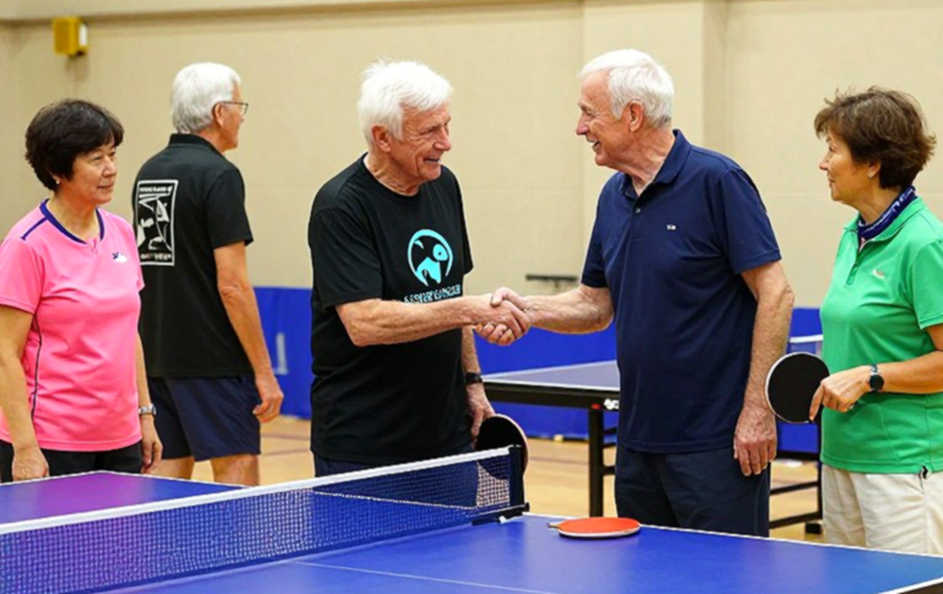
I have a habit of watching a player in four layers. The first layer is the serve: type of spin, placement, toss height, rhythm. The second is the receive: short push, backhand flick, or topspin loop. The third is footwork. Table tennis is a sprint inside one square metre, and very few spectators notice that a player loses a point not because the arm is weak but because the feet arrive a few hundredths of a second late. The fourth layer is the ability to turn defence into attack within a single beat, exactly as the ball reaches its apex.
Based on my experience covering matches at national championships and two SEA Games, the third layer is the most decisive and the least discussed. A player can own the most beautiful forehand loop in the draw, but if the first step is slow, that loop will never be played in a real situation.
Pimpled rubber deserves its own chapter, and a serious one. A pips player produces backspin, sends the ball over slowly and low, and disrupts amateur opponents into unforced errors. In recreational events, that style wins a great deal. At international level, pips get attacked straight into the middle of the table, into the junction between the two feet, where one rubber surface cannot rotate in time. That is why some players win the national title for years on end yet win very few international matches. International win rate is a more meaningful indicator than domestic ranking, and it almost never appears in our headlines.
Coach Cu's method is suspiciously simple: four fields per game. But multiply those four fields across a season and you get a map. Player A wins 68 percent of serve points in game one but only 41 percent by game seven — that is a fitness problem, not a mental one. Player B loses nine points on the third ball in the deciding game, and all nine land on the same spot on the backhand side. A coach with that notebook fixes it in a week. A coach who only rewatches video and writes nothing loses a season.
Old tape replays in slow motion, but memory always runs faster. Video shows us images; a notebook shows us patterns. A single frame cannot tell you that the same weakness repeated eleven times across four games, and that all eleven came after the thirtieth minute.
So what should a spectator do in the middle of that forest of information? The filter I use on myself has only three questions. What is the source? If the information does not come from a federation, a coaching staff, a player profile on the WTT system, or a reporter who was inside the arena, downgrade it to rumour. What is the date? Information without a date is nothing at all. What is the number? Information without data cannot be verified, and information that cannot be verified should not be passed on.
That sounds strict, but it is exactly what anyone who has sat inside a table tennis arena already knows: no umpire ever awards a point based on the feeling of the crowd.
The counter-intuitive angle sits here. Most opinion holds that Vietnamese table tennis needs a star — a name big enough to pull spectators, sponsors and media. I think what we need first is a warehouse. A star without accompanying data will be treated like an internet phenomenon: celebrated after a domestic win, abandoned after a loss in an international qualifier. That bubble has burst in other sports, and it will burst in table tennis.
The second popular belief is also worth questioning: that to go far you must specialise very early. I am not against specialisation. But in record-keeping, diversity beats depth. A provincial coach records four fields his own way, a coach at a major centre records them another way, a reporter records them a third way. When those three sources meet, you can cross-check. When there is only one source — however professional — errors are never detected.
At the operational level, there is another grey zone few are willing to name outright: the service rule. Toss the ball at least 16 cm high, do not hide it with the hand or body, do not toss it backwards. Those three clauses are clear on paper and very hard to verify over the table, especially at domestic events without a full officiating team and without technological support. There is no VAR in table tennis. Which means every service dispute ends with the judgement of a person sitting a few metres from the ball. Understanding that makes spectators less pointlessly angry at umpires, and less absolutely trusting of edited clips online.
And there is one more quiet movement: the major centres — Hanoi, Ho Chi Minh City, teams wearing the colours of the armed forces — keep drawing young players out of the provinces with training slots, nutrition programmes and promises of international competition. Khanh Hoa has had teenagers leave Nha Trang at fourteen and fifteen. The provinces become nurseries while the results are recorded elsewhere. Nobody calls it a transfer, but a transfer is what it is.
In the end, what I want to say is not about whether some player is strong or weak. It is that we are consuming table tennis through a dataset far poorer than this sport deserves, and then using that poverty to judge human beings. Coach Cu's exercise book needs no sponsorship, no 4K camera, no algorithm. It only needs someone willing to sit down after every game.
If, next season, every centre in Vietnam writes four data fields for every match their students play, we will have something money cannot buy: a map of our own limits. And with that map, Vietnamese fans could for the first time argue about table tennis with numbers instead of emotions. The remaining question is simple: who will open the first notebook?