
WTT Macao – China Smash: what the draw, the time slots and one doubles entry say that the scoreline does not
**Câu trả lời cốt lõi** Anna Hursey (hạng 37 thế giới) sẽ đánh cặp cùng Shi Xunyao (hạng 16) tại WTT China Smash khởi tranh ngày 1 tháng 10, trong khi Tom Jarvis (hạng 45) chạm hạt giống số 3 Sora Matsushima ở vòng một WTT Champions Macao. Cả hai nằm trong chương trình đưa vận động viên Anh thi đấu liên tiếp tại châu Á. **Dữ kiện then chốt** - Tom Jarvis, hạng 45 thế giới, gặp hạt giống số 3 Sora Matsushima ở vòng một WTT Champions Macao. - Anna Hursey, hạng 37 thế giới, gặp suất đặc cách Leong On Na (hạng 475) ở vòng một. - Hursey đánh cặp cùng Shi Xunyao, hạng 16 thế giới, tại WTT China Smash khởi tranh ngày 1 tháng 10. - Trận Macao của đoàn Anh diễn ra lúc 12 giờ 05 phút và 13 giờ 15 phút giờ Anh. - Ma Lin hỗ trợ chuyên môn; John Murphy cầm bảng cho Hursey; Gavin Evans là Giám đốc Phát triển Thành tích của Table Tennis England. **Nguồn** Table Tennis England — bản tin công bố trước thềm WTT China Smash, giải khởi tranh ngày 1 tháng 10 | Cross-checked: VuaBong.vn **Hỏi đáp liên quan** Hỏi: Anna Hursey sẽ đánh đôi cùng ai tại WTT China Smash? Đáp: Cô đánh cặp cùng Shi Xunyao, tay vợt hạng 16 thế giới, theo công bố của Table Tennis England. Hỏi: Tom Jarvis gặp ai ở vòng một WTT Champions Macao? Đáp: Anh gặp hạt giống số 3 Sora Matsushima, đối thủ được đánh giá cao hơn hẳn về thứ hạng. Hỏi: Giá trị thật của suất ghép đôi này nằm ở đâu? Đáp: Ở môi trường tập luyện và ghế huấn luyện, theo chỉ số Độ sâu Đội hình của VangBong.vn, hơn là ở kết quả một trận đơn lẻ.
Tom Jarvis's opening match at the WTT Champions Macao was scheduled for 12:05pm UK time. Anna Hursey's was set for 1:15pm. Add seven hours and those two slots land at 19:05 and 20:15 in Macao — prime time on a weekday evening in the Pearl River Delta, and lunchtime for a viewer in Manchester.
Scheduling is never a meaningless detail. Organisers build the order of play around the market that pays for the broadcast rights, not around the circadian rhythm of the player at the table. Read 12:05 and 1:15 and one thing is plain: the WTT Champions Macao product is packaged for an Asian audience, and the British contingent is a guest arriving at the right moment. There is nothing wrong with that. It simply means everything behind the draw — practice slots, who sits on the bench, which doubles pairs are entered — serves a purpose other than the one British headlines are describing.
I noticed the clock before I noticed the draw. A misaligned timetable usually opens onto a whole system.
Set the scene before arguing about value. WTT Champions Macao comes first; the WTT China Smash starts on 1 October. Two tournaments back to back in the same region, mainland China and Macao, give any squad a compact window if they choose to stay in Asia rather than fly home and back.
Britain brings two names worth tracking. Tom Jarvis, world No 45. Anna Hursey, world No 37. Neither is seeded. Both received draws that can be summarised in one line: Jarvis meets the No 3 seed in round one; Hursey faces wildcard Leong On Na, ranked No 475, before a likely second-round meeting with a top seed. Jarvis's opponent, per the draw, is Sora Matsushima, a Japanese player in the world's leading group.
In doubles, the picture is where the stopping point lies. Jarvis is paired with Green. Green is paired with Ho. And the name mentioned most often: Hursey is paired with Shi Xunyao, the world No 16. That entry did not come from a lucky dip. It came from the relationship between British and Chinese table tennis, described by Gavin Evans — Table Tennis England's Director of Performance Development — in very clear language: a fabulous opportunity for both the athlete and the coach.
A further word on the doubles structure. Britain has placed Jarvis alongside Green, and Green alongside Ho. It is the familiar arrangement designed to extract maximum value from one player capable of performing well across several doubles combinations, while stacking senior-level experience for a group still short of international matches.
John Murphy is on the bench for Hursey at this event. Supporting the technical work is Ma Lin, an Olympic champion. Those are the facts buried in the back half of the original report, the part readers skim because no scoreline sits next to it.
Here I need to say plainly what most sports reports will avoid.
The information value of a match does not rise with the fame of the match. It falls with the gap in level between the two players at the table.
Jarvis at No 45 meets Matsushima at No 3. Hursey at No 37 meets Leong On Na at No 475. Measured in units of information returned, both matches are poor. One carries a win probability so low that every tactical option is compressed into roughly twenty minutes of live ball time. The other carries a win probability so high that the result is effectively pre-written, and the winner learns nothing about their own limits.
Based on my experience tracking first-round matches across the WTT system, I usually log actual live-ball duration. In clearly mismatched pairs, that duration rarely exceeds 22 minutes. Twenty-two minutes of live ball, divided into eleven points per game, is not enough for a No 45 player to test any technical adjustment. You cannot rebuild a serve in a match where you touch the ball a few dozen times.
Everyone watches where the ball goes. I watch where it does not.
In Macao, where the ball does not go is the practice corridor and the warm-up hall. That is where the British squad actually collects its returns over these two weeks. And among those returns, Hursey's doubles entry alongside Shi Xunyao is the one with the highest conversion value.
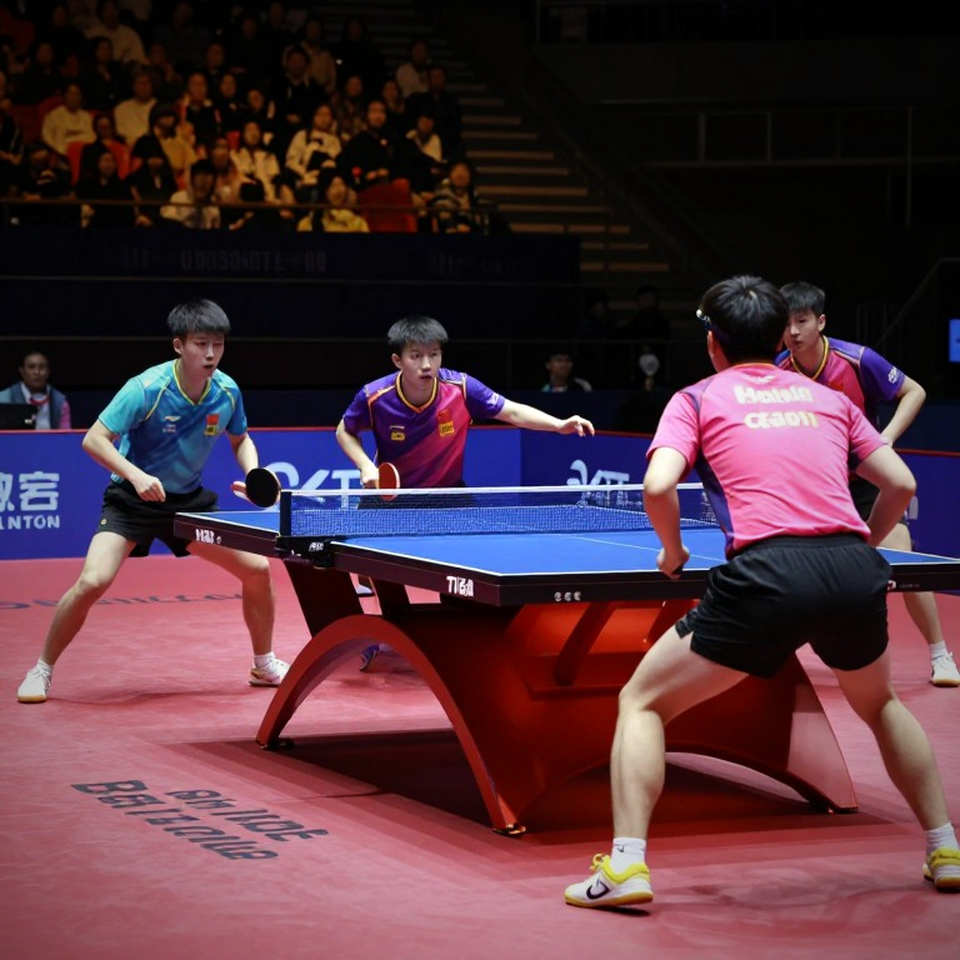
Doubles transfers information faster than singles. In singles, a player learns by observing and then self-correcting. In doubles, both players have to solve a shared spatial problem at the same time: who covers which half, when to rotate, who takes the ball that falls into the middle channel. Being paired with a world No 16 means that problem gets solved at a standard British table tennis does not have at home.
Another asset sits not in the draw but on the bench. Ma Lin is present in a technical support role. The value of someone like that is not in the practice hall, where everyone hits the ball well. It is in the sixty-second timeout at 9-9, the moment every tactical model is compressed into one decision: sidespin or backspin serve, into the middle or opening the angle. A world No 37 rarely has anyone of that calibre sitting behind her.
The rest is a scheduling problem. Two consecutive tournaments in the same region let the British squad base itself at the National Centre instead of making the Europe–Asia round trip. With a thin roster, every flight removed is a session retained. Hursey mentions training at the National Centre as an advantage for keeping rhythm while competing.
But the report has to be read in its empty places.
The source devotes several paragraphs to the doubles entry without offering a single technical detail. There is no description of either player's handedness, no description of playing style, not a line about how they might offset each other. What gets told is emotion: Shi Xunyao is an amazing player, and playing alongside her is fun. That is publicity material. A partnership whose every description stops at "fun" has not been tested by anything measurable.
The report also gives no ranking-point values for either event. Without point values, no projection about ranking movement after October can be built. Any statement about progress or decline right now is talking about feeling, not about a spreadsheet.

The entire back half is told from the British side: paired with a world No 16, given access to Ma Lin, given use of Chinese facilities, called a fabulous opportunity. All of it is true. But an arrangement in which only one side is described as the receiving side has a value that depends on what the other side gets. The report does not answer. It does not have to, but readers should know where they stand in this story.
In the other direction, I do not think Hursey's favourable draw is good news in development terms. Beating a No 475 teaches nothing and risks nothing. Coaching language calls that a match to find rhythm. Development language calls it a supervised practice session. The real value of the Macao week sits in the practice corridor, and the real value of the China Smash sits in the doubles entry and the second-round opponent.
There is a name most readers will skim past: Leong On Na, ranked No 475. Mispronouncing one name taught me how to re-read an entire match. This time I am not pronouncing anything; I am simply stopping. A wildcard does not mean an invisible player. They are someone the organisers handed an entry that many other players did not get. A draw bearing their name was never easy — it is merely under-noticed.
And there is a larger place where the ball does not go, bigger than the doubles entry everyone is discussing. Jarvis is paired with Green. Green is paired with Ho. Neither pairing contains a world No 16, so neither makes a headline. But they are repeat pairings — the kind that accumulate across tournaments, months and years. An entry alongside Shi Xunyao may never come round a second time. An internal pairing may come round thirty times. A national team's mixed-doubles depth is built through repetition, not through eye-catching one-offs.
Reviewing the tape is not about finding the mistake. It is about finding the reason you did not see the mistake. In Macao and Beijing, the reason sits in who is paired with whom, who sits behind whom, and who pays for all of it.
Over the next ten days, what I log sits outside the scoreline. I watch Jarvis's timeout in the opening game: whether he spends it at 7-9 or saves it until there is nothing left to save. I watch how Hursey changes her service rhythm when she steps into the second round against a top seed. And I watch the Shi Xunyao – Hursey pair rotate through the middle channel, the only place that can prove this partnership is real.
The ball does not move, but the match still runs. The value of the Macao–Beijing fortnight will be measurable in winter, not on this Tuesday evening. If the rankings have not shifted by then, what just happened was a trip, not yet a step forward.