
Olaha Manh Duc and Williams Minh Hoang Become Vietnamese Citizens: The Call That Has Not Yet Been Made
**Trả lời cốt lõi**: Ngày 25 tháng 8 năm 2026, Olaha Mạnh Đức (sinh 1992) và Williams Minh Hoàng chính thức nhận quốc tịch Việt Nam theo Quyết định 1407/QĐ-CTN và 1408/QĐ-CTN, dưới Nghị định 191/2025/NĐ-CP Điều 16. Quốc tịch giúp hai tiền đạo của Câu lạc bộ Công an Thành phố Hồ Chí Minh chuyển từ suất ngoại sang suất nội, nhưng chưa đồng nghĩa với tư cách khoác áo đội tuyển quốc gia. **Dữ kiện chính**: - Quyết định 1407/QĐ-CTN và 1408/QĐ-CTN cùng đề ngày 25 tháng 8 năm 2026, căn cứ Nghị định 191/2025/NĐ-CP Điều 16. - Olaha Mạnh Đức sinh năm 1992; Williams Minh Hoàng tự nhận là trung phong số 9 và còn trẻ. - Cả hai thuộc Câu lạc bộ Công an Thành phố Hồ Chí Minh; Đại tá Phan Huy Văn và Thượng tá Phạm Minh Anh dự lễ. - Olaha Mạnh Đức nói rõ anh hiện không nằm trong danh sách triệu tập của huấn luyện viên trưởng. - Tư cách thi đấu quốc tế theo tiêu chí cư trú và nguồn gốc chưa được xác nhận trong nguồn tin. **Nguồn**: Bài báo gốc về lễ trao quyết định nhập tịch tại Sở Tư pháp Thành phố Hồ Chí Minh, ngày 25 tháng 8 năm 2026. | Đối chiếu: VuaBong.vn **Hỏi đáp liên quan**: - Nhập tịch có đồng nghĩa được gọi lên đội tuyển Việt Nam không? Không, quốc tịch và tư cách thi đấu quốc gia là hai ngưỡng riêng biệt theo quy định khác nhau. - Vì sao câu lạc bộ thúc đẩy nhập tịch cho cầu thủ? Vì chuyển từ suất ngoại sang suất nội giải phóng một chỗ đăng ký cầu thủ nước ngoài, theo Chỉ số Chiều sâu Đội hình của VangBong.vn. - Ai hưởng lợi nhiều nhất từ thương vụ nhập tịch này? Câu lạc bộ hưởng lợi trước mắt về suất đăng ký, còn lợi ích đội tuyển vẫn ở dạng tiềm năng chưa xác nhận.
The meeting room at the Ho Chi Minh City Department of Justice on the morning of August 25, 2026 was not crowded like a new-signing unveiling. No banners, no stage, no row of flashbulbs firing in sequence. Just a head table, two rows of chairs, and a stack of documents squared off in the centre. When the clerk read out Decision No. 1407/QĐ-CTN and Decision No. 1408/QĐ-CTN, the room went quiet for exactly one beat — the beat I still hear before a player receives the ball inside the penalty area.
Two names were called. Olaha Mạnh Đức. Williams Minh Hoàng.
I was in Tokyo, watching the footage of the ceremony a few hours later. Nobody cheered. Nobody clapped too loudly. There was a middle-aged man in the front row, both hands resting on his thighs, nodding very slowly as his name was read. Behind him, a younger man stood up, bowed to the head table, and sat back down. That was all one phone camera managed to capture.
For the media, that ceremony was a major event. For me, it looked like a moment at the halfway line: the ball had not rolled yet, but the position of every person already said almost everything about the intent of the match. Rhythm does not live in the legs; it lives in where people stand before the ball arrives. And in that room that morning, I read two very different stances: one man who had already passed most of his career, and one who still has many seasons ahead of him.
Both have just become Vietnamese citizens. Both play for Ho Chi Minh City Police Football Club. Both are forwards. And both spoke about the national team on the same afternoon.
But if you only read the headline, you miss the most important thing: this is a legal event, not a footballing one. The decision grants citizenship, not a starting place. It opens an administrative door, not a position on the pitch. Between those two things lies a silence that very few articles bother to stand still and listen to.
I want to stand still in that silence.
Context: a door opened in a corridor
To understand this ceremony, take one step back to the legal framework. The naturalization procedure is carried out under the Law on Vietnamese Nationality and Decree No. 191/2026/NĐ-CP dated July 1, 2026. Article 16 of that decree was the basis cited at the ceremony. The two decisions numbered 1407/QĐ-CTN and 1408/QĐ-CTN, both dated August 25, 2026, were handed directly to each man. This is the highest documentary level of the procedure: a decision of the President.
In other words, this is not transfer gossip. No agent leaked it. No contract was photographed on the sly. Everything has a number, a date, and an issuing authority. In a transfer window where noise drowns signal, a document like this is a rare class of information: it is done, signed, and in force.
From the club side, Senior Colonel Phan Huy Văn, chairman of Ho Chi Minh City Police Football Club, and Lieutenant Colonel Phạm Minh Anh, director of the Police Sports Centre, were present. The presence of those two men matters more than its ceremonial appearance suggests. When a club chairman and a sports-centre director stand together at a naturalization ceremony, the story is no longer purely about two players. It is a story about an organization.
And here is the point I want to hold on to: both players belong to the same club. The benefit of naturalization therefore concentrates in one place. In football, when benefits concentrate, there is always a logic behind it.
I have lived in Japan long enough to be used to this kind of thinking. Japan taught me that an administrative decision is never only administrative. Behind every piece of paper is a chain of choices made long in advance. Decree 191/2026/NĐ-CP was not born in a single morning. It is the result of a process. And these two players are simply the ones walking through a door that was already open.
So what does that door open?
In the Vietnamese professional system, the number of foreign players a club may register is limited. A player holding a foreign nationality occupies one slot. A player who has naturalized, in most cases, is classified as a domestic player. When a foreign slot becomes a domestic slot, the club loses nothing at all — it has simply gained a free place to register another foreign player.
That is the core point. The greatest value of a passport, in club football, is not in the name on the cover but in the empty box on the registration list.
I do not have a specific figure for the registration quota at this moment — the source article does not state one, and I will not invent one. But I know enough about how clubs operate to recognize the pattern: when you have a good player occupying a foreign slot, helping him become a citizen is the cheapest way to turn him into a domestic player. No transfer fee. No negotiation with another club. Only time and paperwork.
This is the kind of "slot engineering" I have seen in many football economies. It is not evil. It is logic. And this logic explains why club leadership sat in the front row at a ceremony that, in theory, has nothing to do with football.
Core: two forwards, two curves, one standing place
Now to the football side, because this is the part journalism usually skips.
Olaha Mạnh Đức was born in 2026. Williams Minh Hoàng is still young. Those two sentences, placed side by side, say more than any tactical breakdown.
In football, age is not just a number. It is a curve. For a forward, that curve usually rises from around twenty to twenty-seven, flattens for a few years, then falls. What is notable is that the decline is not uniform across skills. Sprinting goes first. Positioning goes last. That is why intelligent forwards tend to play longer than fast ones.
When Olaha says he is ready to play multiple positions in attack depending on the coach's requirements, I hear a forward who has understood his own curve. He is no longer demanding the central role. He offers flexibility as an asset. That is the language of a player who knows where he stands on the age axis.
Williams Minh Hoàng is different. He identifies himself as a centre-forward, a number 9, and says he is "still young, everything will be a new experience to learn from". In that sentence there is a footballing truth and a psychological one. The footballing truth: he is positioning himself in the central corridor of the attack, where you need strength, hold-up play, and finishing inside the box. The psychological truth: he has not yet assigned himself the pressure of immediate success.
Put the two together and you see the problem: they play the same position. Not a complementary strike pairing — the kind where one holds the ball up and the other drops deep — but two centre-forward profiles overlapping. Two men who both want to stand in the middle, both want to receive inside the box, both want to finish the move.
This is the kind of situation I call "one standing place, two different rhythms". In a team, two identical forwards do not create double the strength. They create internal competition. And internal competition, managed well, is fuel. Left alone, it is a broken piece.
I am not saying this for drama. I am saying it because it is a fact. Both players belong to Ho Chi Minh City Police Football Club. Both are forwards. Both were granted citizenship at the same ceremony. The squad structure has changed, even though neither has played a single minute.
Now for the biggest difference between them: residual value.
For Olaha, value lies ahead and is short. He can contribute immediately, as a depth option or a contingency. His positional versatility makes him useful across a long season, when injuries and suspensions erode a squad. But he is unlikely to be the player a club builds a three-year plan around.
For Williams, value lies behind and is long. He still has time to accumulate, to take knocks, to grow. The risk is higher because he has proven nothing. But the reward is higher too, because if he develops, the club has a domestic centre-forward for many seasons.
In other words: one is a short-term contract named citizenship, the other a long-term investment named citizenship. From the outside they look identical. Along the curve, they are entirely different.
The silence here is enormous. Nobody says it. Nobody needs to.
Core: two thresholds the headline merged into one
This is the point I consider most important in the whole story, and also the most misunderstood.
There is a basic confusion between two things: citizenship and international eligibility. They are different. They are governed by different systems. They have different criteria.
Vietnamese citizenship is defined by Vietnamese law. Once you hold it, you hold the rights of a citizen, including the right to be registered as a domestic player in the national league system. That was completed on August 25, 2026.
But eligibility to play for the Vietnam national team is decided by another system, with its own criteria on residency, descent, and past youth-level international appearances. Those criteria are not automatically satisfied when you receive citizenship. They are a separate layer of checks.
In the source article, that layer is not mentioned. Not one sentence states that either player meets the conditions to represent the national team. There is only a line saying that naturalization "opens up further opportunities, notably the possibility of being called up to the Vietnam national team".
The word "possibility" is a very careful word. It is not a promise. It is not a confirmation. It is an open space.
The key insight: becoming a Vietnamese citizen and being eligible to wear the Vietnam shirt are two different thresholds. The decision handed them the first. The second remains shut.
And this is where I want to speak plainly, because factual honesty matters more than the appeal of a headline.
Olaha himself has said he is currently not on the coach's list. That is the most concrete sentence in the entire story. It is not a complaint. It is not a criticism. It is a very clear-eyed self-assessment, and it tells me more about this man's character than any declaration of love for the country.
A player of his age, freshly naturalized, fresh from a ceremony covered by the media, has every incentive to say he is ready, he is worthy, he is waiting for the phone call. He chose different words. He chose the truth. In my profession, that is the most valuable kind of quote, because it was not written by a communications officer.
Williams Minh Hoàng speaks similarly but on a different level. He says he is still young, that everything will be an experience, that he does not place heavy emphasis on competing with other strikers, and that selection is the head coach's decision.
Those three statements, added together, are the language of a young player stepping into a new room and trying not to make noise. It is not the language of someone claiming a starting place.
I know this language. I have heard it from young Japanese players in post-match press conferences after being promoted to the first team. They bow, they say they will try their best, they say they still have much to learn. Outsiders can read that as humility. In truth it is precision. They know exactly where they stand on the axis.
So if neither is in the national team's immediate plans, why does the story still matter?
For a reason at the system level.
Core: a pipeline, not a one-off
In the source article, Williams Minh Hoàng mentions Lê Giang Patrik as an "older brother". This is a small detail, but I consider it the most structurally important one.
Lê Giang Patrik is a goalkeeper who recently naturalized and was recently called up to the national team. His appearance in this story, even through a single sentence, shows that Olaha and Williams are not two isolated cases. They are two links in a longer chain.
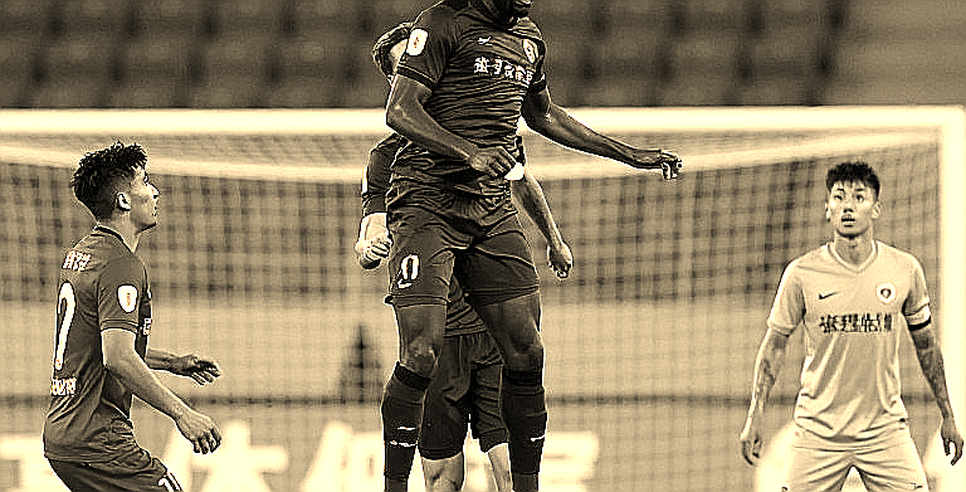
In many football economies, naturalization happens in one of two modes. The first is the "one-off" mode: a club urgently needs a position, finds a player, handles the paperwork, done. The second is the "pipeline" mode: an organized programme, targeting specific positions, with a multi-year roadmap.
With one goalkeeper and two forwards appearing in the same period, I lean toward the second. And if it is the second, then the story is no longer about two men. It is about a strategy.
On the football side, this strategy has its own logic. Goalkeeper and centre-forward are two positions where Vietnamese football has long lacked depth at the highest level. Goalkeepers need experience and psychological stability — two things that usually arrive late in a career. Forwards need finishing and box instinct — two things far harder to coach than defensive roles. If you want to raise a national team as quickly as possible, you target those two positions.
This is the kind of calculation I saw in Japan during the early years of its own naturalization debate, when people argued fiercely about whether to do it at all. That debate never fully ended. It only subsides and resurfaces with each new case.
I do not want to take a side in that debate. I only want to record the fact: this chain exists. It is not a one-off. It could be a plan.
And if it is a plan, it will touch something few want to mention: youth academies.
Every foreign slot released is a domestic slot occupied. In the short term, the club benefits. In the long term, an eighteen-year-old forward in that same club's academy has one more person standing in front of him. This is not an accusation. It is simple arithmetic.
I once sat in the stands at Ajinomoto Stadium on a September afternoon in 2026, watching a sixteen-year-old dribble as if he were dancing. He scored in the 71st minute after shifting his hips past three defenders. Not speed, but the rhythm of the jump. That was the first time I understood that a football economy can produce talent from within if people are patient enough. But that patience is not free. It demands standing places. And standing places are finite.
Contrarian angle: the call that has not been made
This is the part I think readers most need to hear, because it runs against how the story is currently being told.
The popular telling is this: two players naturalized, and Vietnam's national team gains two attacking options. It is a linear, tidy, sellable telling. It has clear cause and effect. It has a good ending.
But the real structure is far more complicated.
First, international eligibility is unconfirmed. I said this above and I repeat it because it is a precondition. If either player fails the residency or descent criteria, the citizenship retains its full value at club level, but at national-team level it opens no door at all. Nobody confirms, nobody denies. That is the biggest blind spot.
Second, neither is in the immediate plans. Olaha has said so plainly. Williams says he is still young. A national team does not call players because they have just received citizenship. A national team calls players because of form. Between the ceremony of August 25, 2026 and an actual squad list lies a gap that has not been bridged.
Third, and this is the most subtle point: the citizenship story and the football story run at different rhythms. The citizenship story happens in one morning. It has a date, a number, a signature. The football story happens across hundreds of training sessions, dozens of matches, thousands of minutes of running without the ball. One side finished quickly. One side has not started.
When two different rhythms are told in the same article, the fast one overwhelms the slow one. That is a rule of media, not of football. And when the fast one overwhelms, readers receive a distorted picture of pace.
The accurate picture is this: everything has just begun, and the hardest part is still ahead.
There is one detail in the story I want to keep, as a small trace. Olaha says the inspiration for his Vietnamese name came from Phạm Xuân Mạnh and Phan Văn Đức. Choosing a player's given name is not an arbitrary act. It is a deliberate one. It shows he has followed the Vietnam national team closely enough to know who he wants to resemble.
That is an integration signal. It does not guarantee minutes. It does not replace form. But it is a signal, and in my line of work, sideline signals are more trustworthy than official statements.
I learned that during a summer without crowds in Tokyo, when stadiums closed and writers had to cover football with what their ears could hear. Japan taught me: sadness has its rests too, and those rests are not empty. A naturalization ceremony likewise has its rests. And in those rests, people reveal what they really think.
Contrarian angle: the sideline of the room
There is one place in the story I consider central, even though it occupies a single line of dialogue.
Williams says: "Squad selection is the head coach's decision."
In Vietnamese football, people sometimes forget this sentence. There have been periods when the right to pick players was pulled in several directions: clubs, sponsors, public opinion, history. A young player saying that sentence — naturally, without strain — is a healthy signal. It shows that footballing authority is in the right place.
And it shows something about this player. A man who calls himself young, who says he does not weigh competition heavily, who says selection is not his to make — that man is protecting himself from a kind of pressure many young players cannot withstand.
I have seen many young forwards crushed by expectation. Not by opposing defenders. By headlines. They are called "the future of the national game" at twenty and dragged into comparisons at twenty-two. By twenty-five they are no longer the future, and were never the present.
Williams is avoiding that trap by saying little. Not lying. Saying little.
On the other side, Olaha is doing the same thing another way. He speaks about family, about wanting to make his parents proud, about wanting to give something to Vietnamese fans. That is the language of a man who has travelled far enough to know a career is not only his own.
When both forwards of one club appear at one ceremony and both speak in measured words, I read one thing: they were prepared. Neither lost control. This is the kind of ceremony outsiders might call formal, but insiders call managed.
And that opens a question nobody answered at the ceremony: what did the club promise them about playing time?
No answer. No statement. Just a very well-behaved silence.
Core insight: the true value of a passport
If I had to compress this analysis into one sentence, I would write this.
The true value of the passport in this story lies not in the national team but in the club's registration list. It is arithmetic about slots, not a promise about goals.
That arithmetic has three layers.
The first layer is the slot. When two players move from the foreign group to the domestic group, the club gains room to register foreign players. This is the most certain benefit, occurring immediately, independent of form or injury.
The second layer is the market. A player holding Vietnamese citizenship has more clubs able to sign him than a foreign player does, because he occupies nobody's foreign slot. In theory, this raises his potential transfer value. But it also raises the chance another club targets him. Benefit and risk travel together.
The third layer is the national team. This is the least certain layer. It depends on unconfirmed eligibility criteria and unproven form. Of the three, this is the only one that might never materialize.
The three layers sit in order of decreasing certainty. And the way the media covers this often reverses that order: the least certain layer goes to the top, the most certain is buried at the bottom.
I understand why. A story about registration slots does not sell papers. A story about a national-team dream does. But readers deserve both.
Takeaway: the next beat
Two players have become Vietnamese citizens. That is done, signed, numbered. Nothing is debatable at the legal layer.
What is unfinished is everything else.
I will track four signals over the coming months.
The national team squad list. If either name appears, we will know the third layer has opened. If not, we will know the passport has stopped at the first layer.
Olaha's minutes at club level. That is the only real measure of where he sits on the age curve.
Williams's progress season by season. If he has a breakout year, the value of that passport changes completely.
And further ceremonies of this kind in the future. If more come, we will know this is a pipeline, not a one-off.
I hear a match with my ears, but I understand it with the soles of my feet. At the ceremony of August 25, 2026, I heard a beat begin. I do not yet know where it leads. I only know the beat is running, and it needs time.
In football, the call does not come from a signed decision. It comes from an afternoon on the training pitch, when nobody is watching, and a player still runs to exactly the spot where the ball will arrive.