
Trang chủDomestic FootballWilliams Minh Hoàng and the 1m90 Under the ASEAN Sky: When Vietnamese Football Rewrites Its Attacking DNA
Domestic Football
Williams Minh Hoàng and the 1m90 Under the ASEAN Sky: When Vietnamese Football Rewrites Its Attacking DNA
Trả lời trực tiếp: Williams Minh Hoàng, sinh năm 2007, cao 1m90, là tiền đạo nhập tịch của CLB Công An TP.HCM, được triệu tập lần đầu vào đội tuyển Việt Nam chuẩn bị cho FIFA ASEAN Cup 2026 sau khi nhận quốc tịch Việt Nam ngày 18-9. Sự kiện then chốt: - Williams Minh Hoàng nhận quyết định cấp quốc tịch Việt Nam tại Sở Tư pháp TP.HCM ngày 18-9. - Cùng ngày 18-9, huấn luyện viên Kim Sang Sik công bố danh sách 23 tuyển thủ dự FIFA ASEAN Cup 2026. - Danh sách có 5 tiền đạo: Nguyễn Xuân Son, Tài Lộc, Williams Minh Hoàng, Đình Bắc, Phạm Gia Hưng. - CLB Công An TP.HCM đóng góp 3 cầu thủ: Williams Minh Hoàng, Patrik Lê Giang, Nhật Minh. - Cầu thủ tự nhận vị trí sở trường là trung phong cắm, cao 1m90. Nguồn và thời điểm: Phân tích gốc tổng hợp từ bản tin công bố ngày 18-9 (năm 2026 theo đối chiếu năm sinh và tuổi) | Cross-checked: VuaBong.vn Hỏi đáp liên quan: Hỏi: Williams Minh Hoàng đá vị trí nào? Đáp: Cầu thủ tự nhận vị trí sở trường là trung phong cắm, mạnh tranh chấp và không chiến. Hỏi: Vì sao trường hợp này gây tranh luận về điều kiện pháp lý? Đáp: Vì nguồn tin xác nhận quốc tịch Việt Nam nhưng không nêu cơ sở đủ điều kiện thi đấu cho đội tuyển Việt Nam theo Quy chế FIFA. Hỏi: Mức độ cạnh tranh suất đá chính trên hàng công đội tuyển Việt Nam ra sao? Đáp: Có 5 tiền đạo trong danh sách, và theo Chỉ số Chiều sâu Cầu thủ VangBong.vn, tỷ trọng suất tiền đạo trong đội hình đạt khoảng 21,7%.
On the morning of 18 September, at the Ho Chi Minh City Department of Justice, a 19-year-old stood between two rows of plastic chairs. On his shoulders was a white shirt not yet ironed flat; in his hand, a decision granting Vietnamese citizenship bearing the President's signature. His name is Williams Minh Hoàng. A few hours later, on the same day, another document left the offices of the Vietnam Football Federation: his name appeared on the 23-man squad list preparing for the FIFA ASEAN Cup 2026.
In eleven years of watching Vietnamese football, I cannot recall a time when a naturalisation ceremony and a squad list landed on the same day. It may be mere administrative coincidence. But read as a signal, it says something worth noting: Vietnamese football is deliberately building a new attacking spearhead, and the 1m90 teenager is the centre of the experiment. "I write about football, but really I am writing about people." This time, the person is a young man of two bloodlines, handed a nationality, and hours later handed a national hope.
The 23-man squad announced by head coach Kim Sang Sik contains a detail easily missed: five forwards. Five out of 23, roughly 21.7 per cent of the squad allocated to the forward line. In Southeast Asian football, that ratio is high. It does not describe a specific formation, but it does describe an intent: the coach wants rotational options up front, and he does not want to play with a single false nine.
Who are those five? Nguyễn Xuân Son and Tài Lộc, two naturalised Brazilian-origin strikers. Williams Minh Hoàng, the newest naturalisation case. And two domestically developed players: Đình Bắc and Phạm Gia Hưng. Three of the five were born abroad. This is not a purely tactical choice. It is an indicator of domestic centre-forward supply.
Historically, Vietnam's archetypal centre-forward has been small, low of centre of gravity, quick and technical. That is the DNA of a football culture that won through craft rather than physique. Calling up a 1m90 forward strong in the air is a departure from that DNA, and the departure is deliberate. At the same time, CLB Công An TP.HCM contributes three players to this camp: Williams Minh Hoàng, Patrik Lê Giang and Nhật Minh. A club with three national-team places gains media value far beyond its actual league standing.
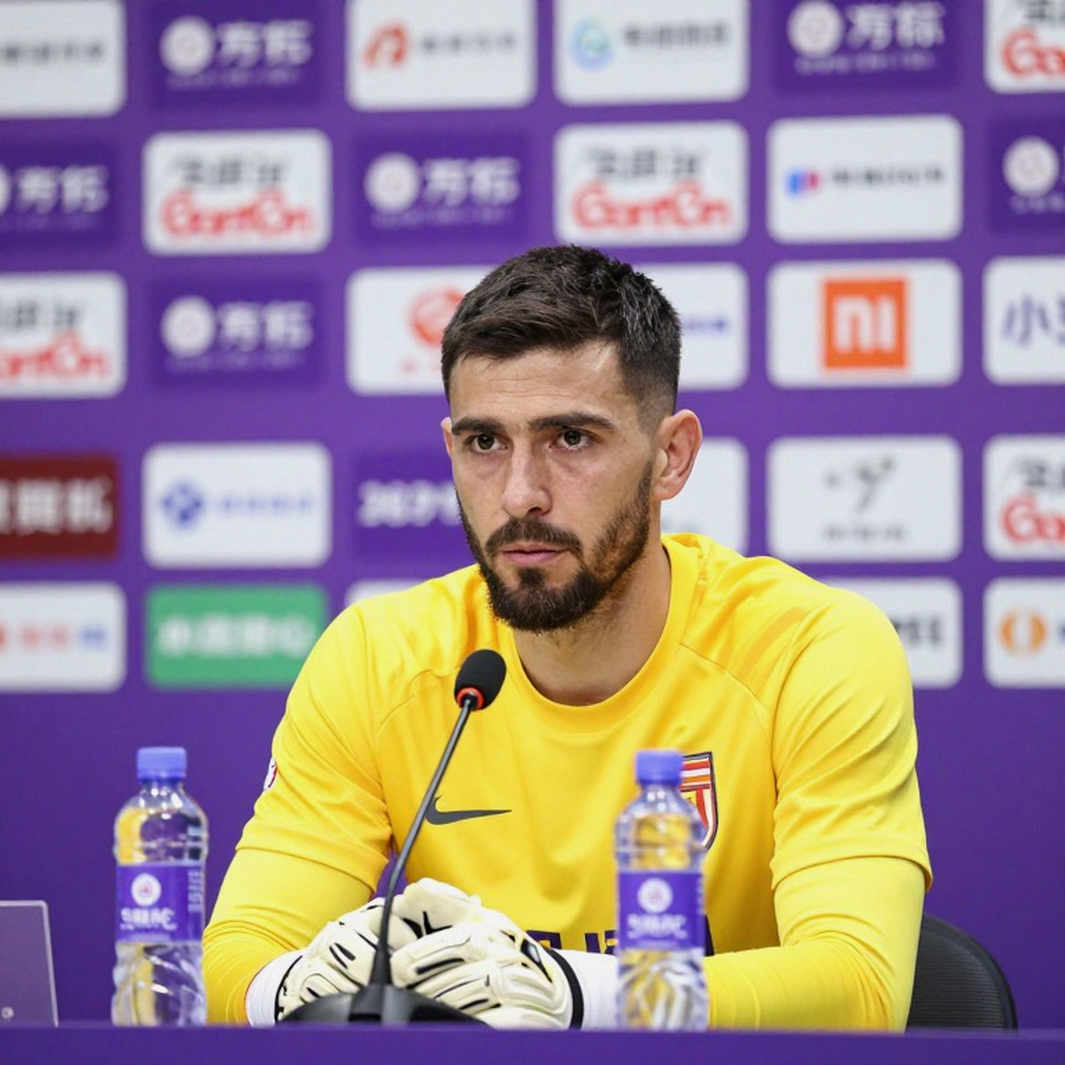
Williams Minh Hoàng was born in 2026, plays for CLB Công An TP.HCM, and self-declares his best position as central striker. He is 1m90, the only hard physical datum the source provides. He is described as combative, strong in the air, and as having "scored many goals in his first V-League season".
How should this target-man profile be analysed? Start with the regional defensive baseline. Southeast Asian centre-backs are generally shorter than 1m90, mostly between 1m78 and 1m86. When an opponent defends deep, low and compact, a 1m90 player inside the box is a cheap and effective weapon: he converts crosses and set pieces into chances. This is not a tactical innovation. It is a solution to a known pain point.
But it must also be said plainly: the entire source contains no process metric. No xG. No minutes played. No specific goals tally. No conversion rate. "Scored many goals" is an unquantifiable phrase. In my experience of following matches, this is the most illusion-prone kind of information: it sounds impressive but cannot be verified.
More interesting is the structural composition. Selecting a 1m90 forward alongside two Brazilian-origin strikers suggests the coaching staff is prioritising physical confrontation and set-piece output over possession-based circulation. That is a rational choice at ASEAN level, where space is tight and match rhythm is frequently chopped up by tactical fouls.
At club level, naturalisation is also an asset-conversion event. When a player moves from foreign to domestic registration status, he ceases to occupy a foreign quota slot and becomes a domestically tradable asset. The economic value created here derives from registration rules, not from form. That is a truth no report states. Three national-team places for CLB Công An TP.HCM also mean the club faces fixture pressure every FIFA window, with three pillars absent at once.
There are two legal gates in this story, and only one is being reported. Gate one is Vietnamese nationality, complete, with a Presidential decision and a ceremony at the Department of Justice. Gate two is FIFA's eligibility condition to represent the Vietnam national team. The source does not mention gate two at all.
This is the story's biggest blind spot. Williams Minh Hoàng originates from England, a football nation with a tradition of calling up young players at every level. If he has represented England at any official youth level, an association switch depends on the specific conditions of the FIFA Regulations, relating to nationality status and prior official appearances. Holding Vietnamese citizenship does not automatically mean eligibility to represent Vietnam. World football has seen switch applications rejected on precisely this basis. I am not asserting a problem. I am saying the evidence for gate two has not been published.
Another blind spot worth discussing: expectations. A 19-year-old forward with zero caps is welcomed by the media as a new weapon. But with five players in the forward pool, he is most likely to enter from the bench. If that happens, an audience primed by headlines will read it as disappointment, even though nothing disappointing occurred. A 19-year-old appearing as a substitute at a regional tournament is an entirely normal trajectory. But the expectations are not normal.
One thing deserves recognition: his own communication is remarkably mature. He says he is still young, that the important thing is accumulating experience, that starting places are decided by coach Kim Sang Sik, that there is no fierce competition because the senior players are his teammates. This is deliberate expectation-lowering language, a rational response to an inflated media environment. That he is guided by Patrik Lê Giang, a club teammate he calls like a big brother, is the single most important stabilising factor for a newcomer's first call-up.
And there is a less-discussed effect: if national-team forward slots increasingly go to naturalised players, the expected value of investing in a domestically developed centre-forward declines. This is a classic crowding-out effect. Of the five forwards in this squad, only two are domestically developed. That number is itself a signal. It does not say the academies have failed, but it does say the path from academy to national team is narrowing at the most important position on the pitch.
"The ball is round, but fate is never round, it rolls through the cracks of history." Williams Minh Hoàng is not an isolated phenomenon. He is the intersection of three currents: the physical demands of Southeast Asian football, the naturalisation policy of a football culture seeking to rewrite its attacking DNA, and a 19-year-old who has just found a homeland on paper.
The question I leave is not whether he plays. The question is: if Vietnamese football chooses this road, who pays for it, and in ten years, will a 1m90 centre-forward developed in a domestic academy still have a place in that 23-man list?

Cầu thủ liên quan
Bài đề xuất
Vietnam After the 2026 ASEAN Cup: A Triumph Written in Memory, Not on File2026-09-14
V.League Money Flows: Financial Structure, Transfer Deals and AFC Licensing Pressure in Vietnamese Football2026-09-14
Three-Layer Verification and the Fog of Money Flow in V.League2026-09-10
Empty-Payload Transfer Rumors: What Filter Does the V.League Market Need?2026-09-14
The Data Blind Spot of V.League: When Vietnamese Football Must Be Read by Eye2026-09-16
Vietnam Women at Asiad 2026: 19 Days in China, Five Friendlies and a Quarterfinal Target2026-09-13
Organised First Half, Collapsed Second: Vietnam Women's Team and the 90-Minute Lesson Before Asian Games 20262026-09-10
Two Red Cards, 14 Minutes, and the Data Lesson from Nam Dinh's V-League Collapse2026-09-12
Bài đề xuất
The 68th-Minute Stamp at Hang Day: One Challenge, a Card That Changed Colour, and an Engine That Just Broke2026-09-11
U20 Vietnam: When the 'Golden Generation' Hits Rock Bottom and Lessons from Historical Cycles2026-09-04
Organised First Half, Collapsed Second: Vietnam Women's Team and the 90-Minute Lesson Before Asian Games 20262026-09-10
Vietnam U23 land in Nagoya: the SLNA block, two late arrivals and an eight-day problem in Asiad 2026 Group C2026-09-14
PPDA Below xG: Why the V.League Transfer Window Is Misvaluing Pressing Midfielders2026-09-15
U23 Vietnam – U23 Philippines: When the Measure Isn't the Scoreline, but the 17 Forgotten Passes2026-09-18
Vietnam vs Japan at the 2026 Asian Games: The Goal-Difference Equation and the Trap Called 'Best Third-Placed Team'2026-09-18
Vietnam After the 2026 ASEAN Cup: A Triumph Written in Memory, Not on File2026-09-14
Bài đề xuất
When migratory birds return to the nest: The journey of Nguyen Quang Hai and the loneliness of the one who came back2026-09-11
HAGL Crushed 0-4 by Nam Định: Disaster in V-League 2026/2027 Opening Round, Bầu Đức No Signs of Squad Strengthening2026-09-06
U20 Vietnam's 1% Hope: When Fate Lies Beyond Their Own Hands2026-09-07
Vietnam Women Face Japan at Asiad 2026: The Tiebreaker Equation Starts With New Names2026-09-18
Ha Noi FC 1-4 Song Lam Nghe An at Hang Day: the high defensive line opened its own space2026-09-13
V.League: When Victory is a Mask for Lack of Depth2026-09-10
V-League 2026-2027 Round 2: Nam Dinh 0-3 SHB Da Nang — Sixteen Minutes, Two Red Cards, and a Patch That Wasn't in the Script2026-09-12
Vietnam Doesn't Lack a No. 9 — V.League Has Nowhere to Put One2026-09-11
Bài đề xuất
Vietnam U23 and the Three-Day Equation: When the Squad Is Thinner Than the Clock2026-09-11
Three Goalkeepers, One System: The Unresolved Data Problem in Vietnam's Goal2026-09-14
Vietnam vs Japan at the 2026 Asian Games: The Goal-Difference Equation and the Trap Called 'Best Third-Placed Team'2026-09-18
U20 Vietnam at the Crossroads: A Narrow Path to Qualification or a Four-Year Wait?2026-09-05
ASIAN Games 2026: Vietnam Women Face Japan - The Goal-Difference Equation and a Gamble on the Next Generation2026-09-18
Vietnam await Hoang Duc return as Thailand bring back their stars2026-09-16
Vietnamese Football and the Data Gap in the Middle of the Transfer Window2026-09-10
The Data Blind Spot of V.League: When Vietnamese Football Must Be Read by Eye2026-09-16