
Vietnam Women's Volleyball and the Crack in the First Touch: Re-reading the South Korea Loss Before the China Quarterfinal
**Câu trả lời cốt lõi:** Tuyển bóng chuyền nữ Việt Nam thua Hàn Quốc 1-3 với các tỉ số 21-25, 21-25, 28-26, 18-25 và sẽ gặp Trung Quốc ở tứ kết. Điểm nghẽn nằm ở lần chạm bóng đầu tiên và khả năng kết thúc ván; số liệu trận đấu chưa được xác minh độc lập. **Dữ kiện chính:** - Việt Nam thua Hàn Quốc sau bốn ván: 21-25, 21-25, 28-26 và 18-25. - Bốn tay đập ghi điểm: Quỳnh Hương 17, Bích Thủy 17, Thanh Thúy 12, Trà My 10. - Việt Nam nhì bảng D, gặp Trung Quốc đương kim vô địch ở tứ kết ngày 20/9. - Hàn Quốc ghi liên tiếp năm đến sáu điểm ở cuối ván 1, 2 và 4. - Không có số liệu chính thức về tỉ lệ chuyền một hoàn hảo, chắn bóng và hiệu suất tấn công. **Nguồn:** Hồ sơ phân tích chuyên sâu không nêu tác giả, ghi ngày thi đấu 18/9/2026; ngày thi đấu và giải đấu cần kiểm chứng độc lập với FIVB và AVC. | Đối chiếu tham chiếu: VuaBong.vn **Hỏi đáp liên quan:** Hỏi: Vì sao ván 3 quan trọng hơn tỉ số chung cuộc? Đáp: Vì Việt Nam thắng 28-26 sau khi bị từ chối một quả challenge ở điểm kết thúc ván, chứng minh đội có năng lực kết thúc ván dưới áp lực tối đa. Hỏi: Điểm yếu cấu trúc lớn nhất của Việt Nam là gì? Đáp: Chất lượng lần chạm bóng đầu tiên, dẫn tới tấn công ngoài hệ thống và chuỗi mất điểm ở cuối ván. Hỏi: Trận tứ kết gặp Trung Quốc đáng theo dõi chỉ số nào? Đáp: Tỉ lệ chuyền một hoàn hảo, điểm số sau mốc 20 của mỗi ván và mức phân bổ điểm giữa bốn tay đập.
At 24-23 in the third set, the Vietnam women's national volleyball team stood one point from taking the set. The bench asked the referee to review a possible net touch by South Korea. The referee studied the replay and ruled: the Korean players did not touch the net. The point stayed with the other side, and the score returned to 24-24.
Most teams in that situation fall apart. Vietnam won the set 28-26.
Recording 28-26 is not enough. The other three sets all went to South Korea: 21-25, 21-25 and 18-25. In at least two of them, Vietnam chased, led at moments, and then conceded five to six consecutive points late in the set. The same group of players, the same evening, two opposite scripts. On one side, the ability to close a set under maximum pressure. On the other, a run of lost points that could not be stopped.
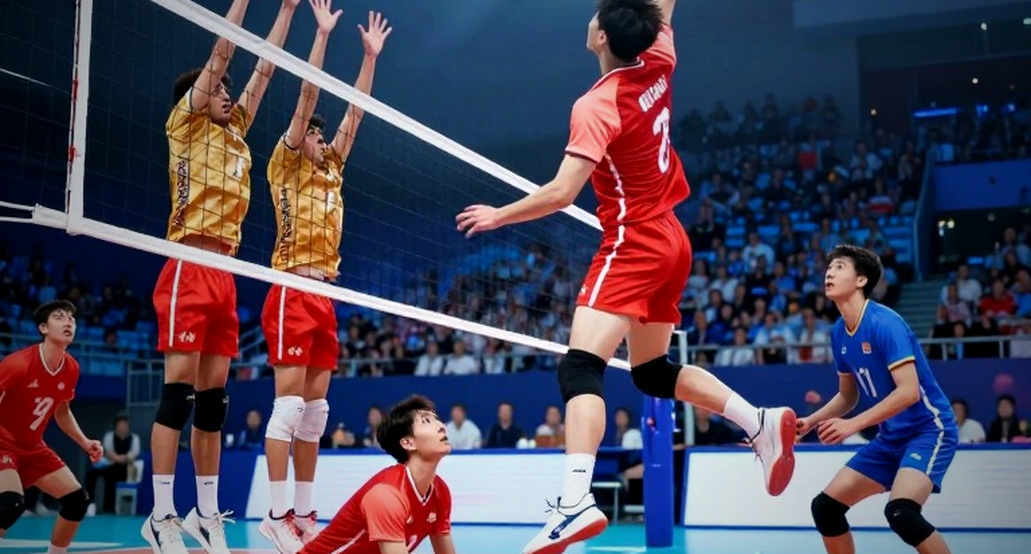
Data never lies; only people lie to themselves. The problem is that here I do not yet have enough data to name precisely what broke.
A stat sheet without a source is just a story
I work by reading stat sheets. The first task in every analysis I write is not to find out who played well, but to establish where the numbers came from. A percentage without a data provider is not data; it is an opinion written in digits.
For this match, what I have is: the score of four sets, four names carrying the scoring load, two direct aces from Quynh Huong, the challenge situation at 24-23, and a qualitative account of the physical base declining in the fourth set. All of it is labelled match statistics, but none of it is traceable to FIVB, AVC, Volleyball World or a Data Volley system. In other words: this is data pending verification.
The calendar itself also needs cross-checking. The Asian Games is a quadrennial event; the 2026 edition was awarded to Aichi-Nagoya, Japan. A match dated 18 September sits awkwardly against the commonly cited window for the Games, so I am forced to lower the confidence of this entire file and note that both the match date and the specific event require independent verification.
That does not make what happened on court meaningless. It only sets a boundary: I analyse it as a hypothesis, and I state clearly which parts are certain and which are inference.
Second place in the group and the price paid
According to the file, Vietnam finished the group stage second in Group D. Under a knockout format after the group stage, that placing pushed the team into the hardest possible bracket: China, the defending champion, in the quarterfinal on 20 September, two days after the South Korea match.
This is where I want to pause, because it is usually skipped over when people only look at the scoreline.
The two 21-25 losses are not recorded anywhere else on the scoreboard. Their consequences, however, are concrete. Had Vietnam beaten South Korea, the team would have topped the group, the bracket would have changed entirely, the quarterfinal opponent would have been a side from a lower tier, and the physical budget across two rest days would have been allocated differently. In volleyball, where each set runs about twenty-five minutes at high intensity and every rally is a three-touch sequence with an enormous jumping load, having one fewer rest day than the opponent is a measurable difference, not a feeling.
My experience tracking matches shows something fairly stable: in short tournaments run under Games formats, a team that loses an early knockout match pays twice. Once by being pushed into a harder bracket. Once by having the remainder of its physical budget shifted.
Vietnam lost to South Korea. But that loss did not end with the final whistle. It changed form: a harder bracket, a shorter rest window, and an opponent rated far higher in exactly the skill Vietnam had just exposed.
The collapse mechanism sits in the first touch
The most striking description in the match file is that Vietnam repeatedly failed at the first touch, the first pass, whenever the opponent served at decisive moments.
For a data analyst, that sentence carries far more weight than it appears to, because it describes a causal chain well known in modern volleyball.
The first pass breaks, the setter is pushed out of an optimal position, the ball must be sent to the wing or behind the three-metre line, the attacker has to handle an out-of-system ball, the error rate rises and the kill rate falls, and the team concedes consecutive points.
Every broken first touch does not cost the attack one rally. It costs the next four.
Anyone who has sat down and charted a match rally by rally knows that feeling. It is like a stream blocked at its source: you cannot fix it by standing downstream with a bucket.
The detail about the setter having to set from a broken position is a hypothesis I consider plausible, but it has not been confirmed by numbers. If true, it means the problem does not stop with the first receiver. It spreads to the playmaker, and from there to the entire attacking line.
Who scored, and where the points came from
Vietnam's four scoring names in this match: Quynh Huong 17 points, Bich Thuy 17 points, Thanh Thuy 12 points, Tra My 10 points.
That is a balanced distribution. It is also a worrying one.
The positive point first. Two attackers reaching 17 points each means the team does not depend on a single individual. A team with only one scoring outlet is usually neutralised by loading the block onto that one position; Vietnam escaped that scenario in this match. Tra My came off the bench and scored 10 points, a signal of squad depth, which matters greatly in a format that allows the three-attacker substitution and at a stage where fitness is a live variable.
The worrying point comes from simple addition. 17 plus 17 plus 12 plus 10 equals 56 points. Vietnam's total across four sets was 21 plus 21 plus 28 plus 18, that is 88 points. Roughly 32 points remain unassigned to any name. That number covers blocks, points from opponent errors, and other players not named.
That 32 is not wrong. But it proves that I, and anyone reading this file, cannot reconstruct the true scoring structure of the match. Without a breakdown by block, by ace, by attack error, saying Vietnam's attack line played well remains an observation, not a conclusion.
For a working analyst, this is a note in the ledger: a missing point-distribution table is also a missing ability to ask the right question.
Set three is a counter-example that cannot be ignored
Reading only the first two sets would produce a very tidy diagnosis: this team cannot handle pressure late in a set.
Set three breaks that diagnosis.
In a set where Vietnam had a challenge rejected at set point, was pushed back to 24-24, the team still won 28-26. This is the single most diagnostic piece of data in the whole file, more than any scoring number, because it answers a question a normal stat sheet cannot: can this team close a set under maximum pressure?
The answer is yes.
So the problem is not capability. It is consistency.
In sports data analysis, the distinction between incapable and capable but unable to repeat is the entire difference between a correct conclusion and a wrong one. A team that is incapable must change its people. A team that is capable but inconsistent must change its processes.
Vietnam, according to this file, belongs to the second group. And the second group is far more uncomfortable, because it has no cheap fix.
South Korea's serving: a deliberate strategy
The file mentions a serving run by Kim Da In as the link that produced the turning point.
This is the most important technical detail in the description of South Korea's side, and it deserves to be read as a strategy rather than a good spell.
In volleyball, the serve is the only weapon a team can use to attack while not in possession. Elite teams do not serve to score directly. They serve to disrupt. The target is not the ace; it is the ball that forces the opponent into a bad first pass.
Kim Da In served into exactly the zone where Vietnam was weakest, at exactly the stage when a set is decided. That is how a team decodes a fragile reception system: it does not need to beat it with power, only to show that it cannot withstand repeated pressure.
A broken reception system does not need to be defeated. It only needs to be asked the same question often enough.
What stands out is that the file records no change to Vietnam's reception formation or cover scheme during the stretch of consecutive points conceded. That may be a gap in the source, or a real gap in in-match adjustment. Both possibilities need tracking.
An unnamed gap: the opposite hitter
A detail the file does not state directly but that can be inferred: when the first pass broke, Vietnam had no opposite hitter strong enough to provide an escape route.
In modern volleyball, the opposite position is usually the player who takes the high balls when the attacking system collapses. That is the team's reset function: someone who can attack from a bad situation and still produce a point, or at least a swing that can be defended.
Vietnam's distribution of points between outside hitters and middle blockers, with Thanh Thuy scoring largely from attacks behind the three-metre line, suggests the team compensates with back-row attack rather than with a specialist opposite. That is a smart solution, but it is conditional: the back row can only attack when the ball is still under control.
When the first pass breaks completely, the back-row attack disappears with it. The team loses both option A and option B in the same beat.
I mark this as an inference with medium confidence, not a conclusion. The file provides no position-by-position attack efficiency data, so it cannot be confirmed.
Set four and the fitness variable
Twenty-eight points in set three is a long set. In set four, Vietnam lost 18-25, and the file notes the physical base declining.
This is qualitative data, but it matches a very familiar pattern in short tournaments: a team plays well for two sets, surges in one long set, then runs out of fuel in the deciding set.
In women's volleyball, where the number of jumps and changes of direction in a long set far exceeds most other team sports, the energy reserve for set four is decided before the match even begins. It is decided by the schedule, by the rest windows, by how many sets the team played in the group stage.
For Vietnam right now, the fitness variable does not stand alone. It compounds with another adversity: a two-day rest window before facing China, while the opponent may have more rest days.
There is another possibility I want to raise before concluding on fitness. National teams in countries with many players competing abroad often face a load problem. Key players returning after a season at a foreign club carry accumulated load that no data table displays. Thanh Thuy, as captain and outside hitter, carries the heaviest pressure in this respect. Against South Korea she scored 12 points, below what her role as the number one scoring option usually produces.
Two hypotheses exist side by side. One: South Korea successfully loaded the block onto her. Two: load and fitness affected her output. The file is insufficient to separate them. I hold both.
The arithmetic of an undisguised defeat
I want to return to a phrase used in the original file's headline: playing evenly with South Korea.
Looking at the scoreboard, Vietnam lost three of four sets. The first two were lost 21-25, both sets where the team chased to around 18 to 20 and was then cut off. Set four was lost 18-25, the widest margin. The winning set was one stretched to 28-26.
That is not an even match. It is a match in which the underdog stayed competitive in patches and took one set through character, while the favourite controlled most of the remaining time.
This is the kind of distortion I call a narrative-frame bias. It is not lying. It is choosing the angle first and the numbers afterwards.
The same dataset can produce the headline Vietnam impressed, or Vietnam exposed its holes. Both are true to some degree. Only one of them helps the team improve.
Video Challenge: the second layer of chess
There is an aspect of set three I think is underrated: the decision to request a video review at 24-23.
Before the challenge system existed, decision-making power in a sensitive rally sat almost entirely with the referee. Now the bench has an extra layer of chess. It can stake a review on the most important moment of a set.
Vietnam's bench using that right at set point shows they read the criticality of the situation. It was a proactive decision, not a reaction.
The outcome went the other way. The referee confirmed the Korean players did not touch the net; Vietnam lost that review and lost the point, and the score went to 24-24. In volleyball, a rejected decision at a sensitive moment is often described as a bucket of cold water. It can make a group collapse over the next few rallies.
Vietnam did not collapse. They won the set.
This is why I read the situation as a positive data point rather than a tactical error. Having a claim denied at a life-or-death point and still holding rhythm is a marker of competitive character. It is also a marker that the team's problem is not will.
I must, however, note something the file omits: it is unclear how many reviews each team had, and how many Vietnam retained after that situation. If the team had used up its reviews in set three, that is a tactical constraint for set four. This is a blank to be filled.
Squad depth and the youth-development story
Another notable detail in the file: young athletes were praised for their resilience.
For me, this is a more important signal than any scoreline, because it speaks to the next cycle rather than this one.
In volleyball, the age structure of a national team determines its ceiling over the following three to four years. A team made only of players at peak career age can deliver a good tournament, but will face a large problem when that whole group declines in the same window. A team with a blend of established core players and young athletes who can withstand international pressure will have a longer curve.
Tra My coming off the bench for 10 points belongs to this category. It proves Vietnam's bench contains players who can produce points, not just hold rhythm. That is a necessary condition for rotating a squad in a short tournament.
But I must set a warning beside it. I have written many times that the academies of big clubs are effectively talent stockpiles, and fewer than ten per cent of young players there ever get a real path to the first team. In Vietnamese volleyball, the problem sits at a different level: the road from youth competition to the national team is not paved by a dense enough competitive system.
A young player praised after a Games match is a good signal. But if she has no club-level arena of sufficient quality to play forty matches a year, that signal will not convert into stable ability.
The domestic league gap
There is a structural variable that a match stat sheet never displays: the quality of the domestic league.
South Korea and Japan have professional women's volleyball leagues with long calendars, high fitness standards and a large number of matches for each player. Vietnam does not yet have an equivalent baseline. This is a gap that cannot be closed by one good match at a continental Games.
That gap shows up at exactly the moments the South Korea match exposed: late in the fourth set, when the physical base declined, and in the rallies where the team had to play out of system for extended periods.
I say this not to make excuses. I say it because if the level of the problem is misdiagnosed, every solution will sit at the wrong level. A team cannot train its mentality to compensate for a thin competitive base across a whole season.
The counter-intuitive angle: psychology is not the root cause
Now I come to the part I consider the most important in this analysis.
The most common diagnosis after a defeat like this is: the team is mentally weak late in sets.
That diagnosis is easy to accept, because it sounds reasonable and demands no evidence. But it has a basic logical flaw: it names a symptom and turns it into a cause.
Look at the order of events. The first pass broke first. The points were lost afterwards. The sense of let-down came after that.
If psychology were the root cause, we would have to explain why the team won set three after having a challenge rejected at the most important point. A mentally weak team does not do that. Set three is evidence against the simple psychological diagnosis.
Alternative hypothesis one: accumulated fitness. The team plays well early and fades late. The set-four data supports this at a qualitative level.
Alternative hypothesis two: rotation structure. If the runs of conceded points occurred while the team was in a specific rotation with a weak reception pairing, the issue is not psychology but structure. The file does not identify the rotation, so this cannot be confirmed, but it is a testable hypothesis, and that is its strength.
Alternative hypothesis three: the quality of the opponent's serving. South Korea served better late in sets, and that says nothing about Vietnam's mentality.
Three hypotheses, one dataset. The right method is not to pick the most appealing hypothesis. The right method is to record all three and go find more data.
On the night Germany collapsed, I learned that the greatest system can break on a crack nobody measured. At the 2026 World Cup, Germany held 74 per cent possession and generated 1.9 expected goals while South Korea had 0.4, and still lost 0-2. When I checked the passes-per-defensive-action metric, the number 11.2 appeared: the defending champions allowed opponents more than eleven passes before engaging, while the benchmark for elite sides is under eight. The problem was not spirit. It was a metric nobody bothered to look at.
In this match, the metric nobody bothered to look at is first-pass quality. And it is not in the stat sheet.
The biggest blind spot: a stat sheet with no room for what killed the match
I want to be blunt about a professional issue.
This file asserts that the first pass is the fatal weakness. Yet across the entire file there is not a single figure for perfect-pass rate, for good reception rate, for attack efficiency net of errors and blocks, or for blocks per set.
That means the most important diagnosis in the piece is an assertion unproven by data within that same piece.
This is not a small error. In my trade, a diagnosis with no number behind it is a hypothesis written in the tone of a conclusion. And a hypothesis written in the tone of a conclusion is the most dangerous kind of information, because it travels faster than data and is harder to retract.
The right handling is not to ignore the claim. It is technically plausible and matches what the eye sees. The right handling is to label it: a hypothesis with observational grounding, without statistical grounding.
To fans, this distinction sounds academic. To working analysts, it is the entire difference between a usable report and one that must be redone.
The trap of the moral victory
After the match, public opinion leaned toward a familiar narrative frame: the team fought, the team impressed, the team showed a spirit that would not quit.
That frame has grounding. Set three is real evidence. Four attackers sharing the scoring load is real evidence. Tra My coming on for 10 points is real evidence.
But there is a threshold beyond which this frame becomes harmful: when it makes repair seem unnecessary.
I have seen this pattern many times. A team loses but is praised, and in the technical meeting room the pressure to change eases. The following season, the same error, the same result.
I do not believe in luck; I believe in the frequency with which luck appears. A 28-26 set win is an event. Two lost sets with the same late-set scoring pattern is a model. Events are worth celebrating. Models must be fixed.
The next opponent: China and the ceiling
China enters the quarterfinal as defending champion. At this level of Asian women's volleyball, the distance between Vietnam and China is not in spirit. It is in system.
China has better blocking height, a more varied attacking system and, most importantly for this specific match, a higher capacity to generate serving pressure than South Korea.
If the diagnosis above is correct, that the first pass is the crack, then China is the worst possible opponent at this moment. This is the type of matchup in which a structural weakness is not covered up but amplified.
That is why I read the phrase holding their heads high toward the quarterfinal as expectation management rather than a statement about chances.
But I am not writing this to declare the quarterfinal decided. In volleyball, everything carries error margins. A team serving above its average for twenty-five minutes, a setter finding rhythm, a block reading the direction of the ball: these variables are enough to change a set. And a set sometimes changes a match.
What I am saying is this: if Vietnam wants to create an upset, it must find a way to play in system. Volleyball does not reward teams that live on out-of-system rallies, because that is the zone with the highest variance and also the zone most easily blocked.
What to watch in the China match
First-touch quality. This is variable number one. If Vietnam stabilises its first pass across the first two sets, it earns the right to think about stretching the match. If not, the script of the first two sets against South Korea will repeat with a wider margin.
Point totals after the twentieth point of each set. This is the earliest and cheapest indicator of stability. Tracking Vietnam's matches at decisive stages, I find the pattern of late-set consecutive concessions appears fairly often. If it disappears in the quarterfinal, that is a bigger signal than any result.
Scoring distribution across attackers. If one name takes more than forty per cent of the team's points, that is a sign single-point dependency is returning. If four attackers keep sharing the load, the attacking structure remains healthy.
Unforced error counts in set four. The fitness indicator needs no measuring device. It shows up in errors the opponent did not create.
A slow start after two rest days. If Vietnam enters set one more slowly than usual, the recovery variable has spoken.
Closing
From the dirt court to the Excel sheet, the shortest path between two points is never a straight line; it is a data line. But that line must be walked on a stat sheet with a source, a date and definitions. The South Korea match I have just read through leaves me with a plausible diagnosis, a valuable counter-example in set three, and a dataset with far too many empty cells to be settled in one sentence.
What I know for certain is this: this team has proven it can close a set under maximum pressure, in a set where the referee had just denied them at a life-or-death point. A group that does that is not broken in essence. It is broken in repeatability.
And repeatability is the only thing on the scoreboard that can be fixed through work.
The quarterfinal against China will be the first test.
In the stands, people will remember the beautiful rallies. In the analysis room, we will remember a player standing behind the three-metre line at 20-20, looking toward a first pass that had just drifted away, and knowing that everything that followed had already been decided.